

Stripe
Connect and manage Stripe accounts for payment processing
Stripe overview
Stripe is the payment processor used by Tiquo to handle all card payments, local payment methods, subscriptions, and payouts.
Stripe provides the underlying payment infrastructure, while Tiquo manages how payments are created, split, attributed, and reconciled across orders, sublocations, and legal entities.
Stripe provides payment security and compliance support across countries and currencies.
Connecting Stripe
To accept payments in Tiquo, you must connect at least one Stripe account to your organisation.
Stripe accounts are connected via Stripe Connect, allowing Tiquo to:
- Create and manage payments securely
- Route funds to the correct legal entities
- Access payment statuses and settlement information
- Support refunds, disputes, and reporting
The connection process requires you to authenticate with Stripe and grant Tiquo permission to operate on your behalf. No card details are ever stored by Tiquo.
Once connected, Stripe becomes available across orders, bookings, memberships, and customer flows.
Stripe accounts and entities
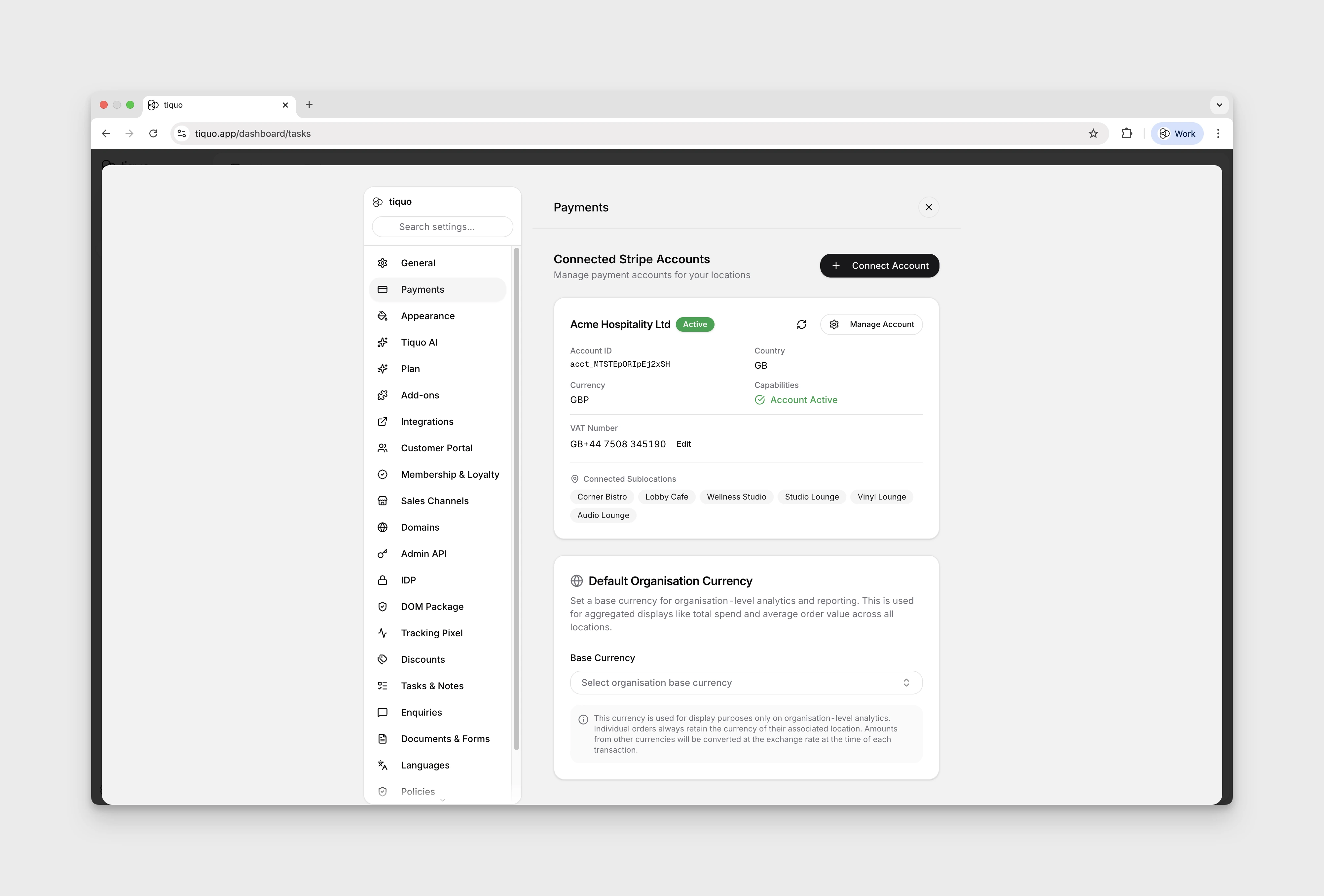
Tiquo supports connecting multiple Stripe accounts within a single organisation.
This is commonly used when:
- Different sublocations operate under different legal entities
- Separate brands or businesses exist within the same group
- Funds need to settle to different bank accounts
Each sublocation can be linked to:
- A specific Stripe account, or
- A shared Stripe account used across multiple sublocations
When payments are taken:
- Orders are always associated with a sublocation
- The sublocation determines which Stripe account receives funds
- Multi-entity payments are automatically split across the relevant Stripe accounts when a single customer payment covers multiple orders
Customers make one payment while funds remain separated by legal entity.