Tiquo
PlatformPayments

Payments Overview

Secure payment collection, settlement, and reconciliation across your business

Payments in Tiquo are designed to support simple single-location setups as well as complex multi-location and multi-legal-entity businesses. The platform handles payment collection, settlement, and reconciliation while abstracting complexity away from staff and customers.

All payments are processed securely and integrated directly into orders, bookings, memberships, and customer journeys.

Payments Architecture

All payments in Tiquo are processed through Stripe.

Global Infrastructure

Payments use Stripe's global infrastructure and compliance standards

Multi-Currency

Supports all countries and currencies supported by Stripe

Fraud Protection

Payment authentication and fraud protection built-in

Compliance

Regulatory compliance and security handled by Stripe

Tiquo's base pricing assumptions are aligned to UK card fees, but actual processing costs may differ internationally depending on Stripe's local rates and supported payment methods.

Tiquo sits on top of Stripe to orchestrate payments across orders, locations, and legal entities.

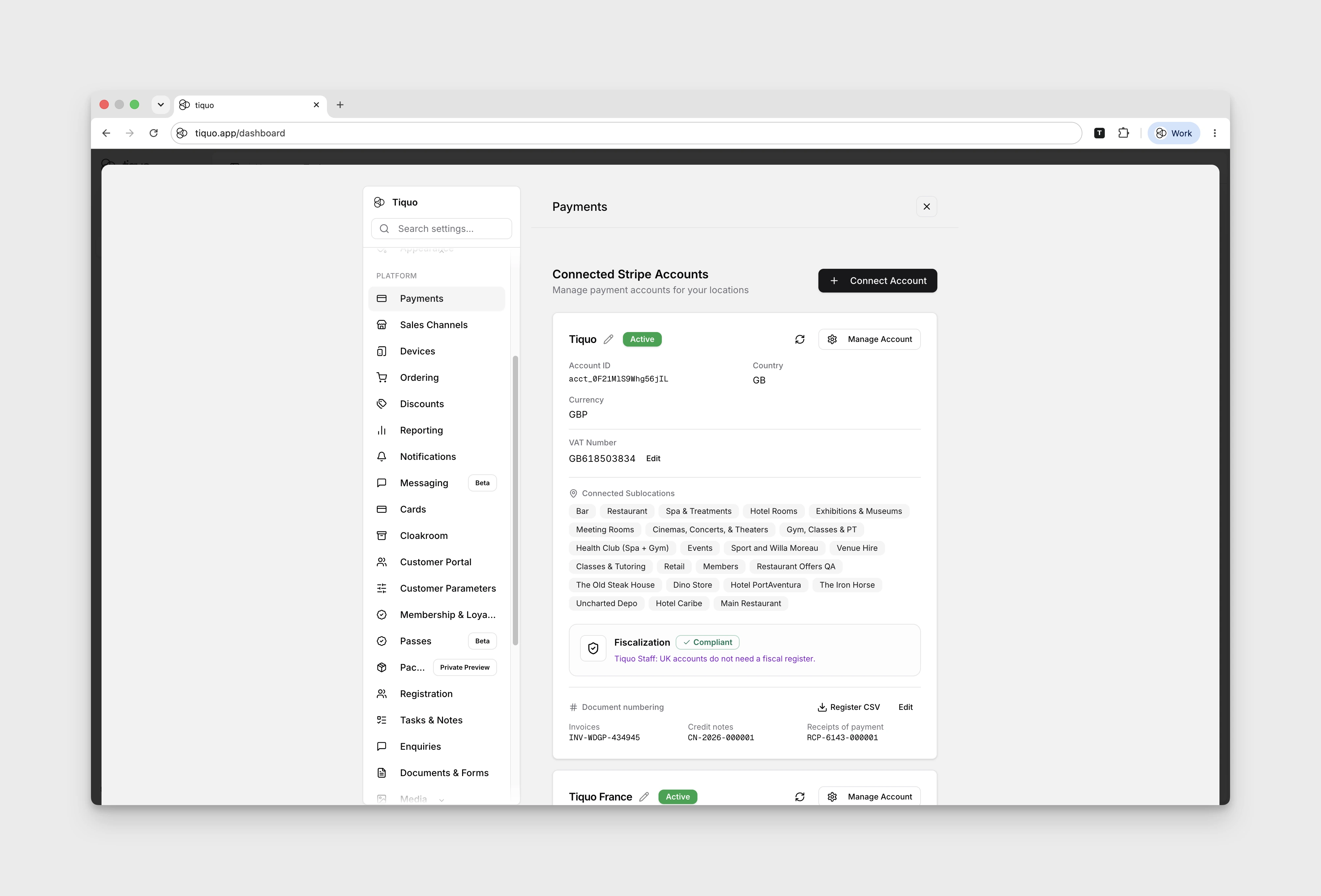
Orders, Sublocations, and Multi-Entity Payments

Payments in Tiquo are closely tied to sublocations and legal entities.

Key principles:

PrincipleDescription
Order AssociationEach order is always associated with a single sublocation
Legal Entity FlexibilityEach sublocation can represent the same or a different legal entity
Sublocation-Level ConfigLegal entity configuration is handled at the sublocation level

Grouped Payments

Tiquo allows multiple orders to be grouped together before payment. For example:

  • Multiple orders linked to the same active booking
  • Multiple orders created during the lifecycle of an enquiry
  • Orders created across different sublocations within the same customer journey

Automatic Payment Splitting

When a single payment is taken from a customer:

  • Tiquo automatically splits the payment across the correct legal entities
  • Settlement is handled based on the originating sublocation of each order
  • No manual reconciliation or cross-charging is required

This enables scenarios such as a restaurant and spa operating under different legal entities within the same hotel, multiple venues contributing to a single guest experience, or customers paying once for services delivered by multiple operators.

From the customer's perspective, the experience is seamless. From the business perspective, payments remain correctly attributed and compliant.

On this page